TOP-RATED GLOBAL SOURCING & E-COMMERCE SOLUTIONS FOR AMBITIOUS BRANDS

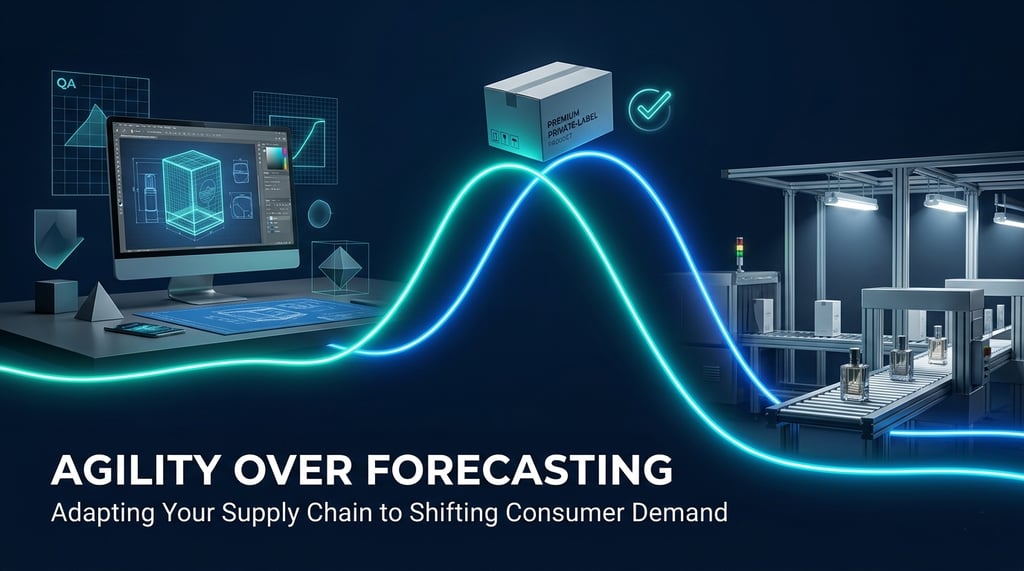
Agility Over Forecasting: Adapting Your Supply Chain to Shifting Consumer Demand
In an era dominated by hyper-accelerated trend cycles and viral commerce, traditional long-term inventory forecasting is no longer enough to keep brands afloat. Learn how scaling e-commerce businesses are leveraging agile manufacturing, flexible MOQs, and rapid private-label development to capture sudden shifts in consumer demand without risking dead stock.
3 min read
Agility Over Forecasting: Adapting Your Supply Chain to Shifting Consumer Demand
For decades, the playbook for retail growth was dictated by predictable, cyclical data. Brands analyzed the previous year’s performance, added a standard growth percentage, and placed massive inventory bets 6 to 12 months in advance.
Today, that playbook is a liability.
The rise of digital commerce, social shopping, and algorithmic virality has fundamentally altered how markets operate. A micro-trend can explode on TikTok Shop overnight, generate millions in demand within days, and vanish just as quickly. In this hyper-accelerated landscape, relying solely on legacy, long-term forecasting models leaves brands trapped in one of two nightmare scenarios: devastating stockouts that surrender market share to competitors, or mountains of capital tied up in dead, unliquidatable inventory.
To survive and thrive, modern digital brands must pivot away from rigid predictive models and focus heavily on building operational responsiveness. Growth no longer belongs to the companies that forecast perfectly; it belongs to the brands built for speed.
1. The Breakdown of the Predictable Supply Chain
Traditional forecasting assumes a linear marketplace. It assumes that lead times are stable and consumer attention shifts gradually. However, modern consumer demand trends are highly non-linear. They are reactive, fragmented, and heavily driven by cultural moments rather than seasonal calendars.
When a brand operates on a rigid supply chain, its reaction time is too slow to catch these waves. By the time a market signal is identified, the order is placed, and a massive factory production run is completed across the ocean, the cultural window has closed. The resulting inventory arrives at the warehouse already obsolete.
To stay competitive, successful digital businesses are decoupling their growth from static forecasts. Instead, they are reimagining private-label brand development through a lens of absolute flexibility—reconfiguring their infrastructure to respond to real-time market signals rather than months-old projections.
2. The Blueprint for an Agile Private-Label Strategy
Transitioning from a forecasting-first mindset to an agility-first model requires a complete overhaul of how a product moves from concept to consumer. This requires optimizing three distinct pillars:
Accelerated Product Development and Quick-Turn Packaging Design
When a new market opportunity presents itself, the product development phase cannot take months. Agile brands utilize rapid 3D prototyping, digital sample iterations, and parallel engineering to compress the R&D cycle from quarters to weeks.
Crucially, this speed must extend to custom packaging. Long-lead packaging pipelines often bottleneck production. By utilizing modular box architectures and quick-turn, localized printing techniques, private-label brands can customize and refresh their presentation on the fly, matching the exact aesthetic expectations of trending consumer cohorts.
Agile Manufacturing and Flexible MOQs
The traditional manufacturing model rewards massive volume with lower per-unit costs. While cost efficiency matters, it loses value if it forces you to order 10,000 units of an unproven trend.
True operational agility relies on agile manufacturing frameworks. This involves partnering with modern, tech-enabled factories willing to offer flexible Minimum Order Quantities (MOQs). By structuring agreements where raw materials or component blanks are pre-staged at the factory, brands can initiate a small, low-risk initial production run to test the market, reserving the right to trigger rapid, large-scale replenishment orders the moment sales data validates the demand.
3. De-Risking the Pipeline: QA and Compliance at Velocity
When you compress the timeline between product ideation and market launch, risk escalates dramatically. Cutting corners to chase a trend is a fast track to product recalls, platform bans, and permanent brand damage. Speed is a competitive advantage only if the product arrives safely and complies with regional standards.
Maintaining momentum requires embedding strict quality assurance (QA) protocols directly into the accelerated workflow. Rather than treating compliance and product testing as an afterthought at the end of the line, it must be integrated dynamically into the product sourcing process:
Pre-Vetted Component Sourcing: Utilizing suppliers whose materials are already certified and compliant with target-market regulations (FDA, CE, FCC, etc.) to eliminate regulatory delays.
In-Line Factory Inspections: Deploying independent inspectors to verify quality during the compressed production run, catching defects on the factory floor before goods are shipped.
By turning QA into a standardized, repeatable step in your rapid-deployment pipeline, you protect your customers and preserve your brand's integrity without slowing down your go-to-market execution.
Turn Agility Into Your Competitive Advantage
The brands dominating modern e-commerce understand that the future cannot be fully predicted—but it can be prepared for. Shifting from a slow, forecast-heavy supply chain to an agile, responsive model turns operational headaches into a powerful engine for market capture.
At ParaUnion, we specialize in bridging the gap between creative vision and fast-moving market realities. We partner with ambitious businesses to handle the complexities of end-to-end private-label brand development, agile product sourcing, flexible factory negotiations, and rigorous quality assurance. We build the backend, so your brand can capture the trends that define tomorrow.
Ready to compress your product development cycle and build a supply chain that moves at the speed of internet demand?
Contact the ParaUnion team today to launch your next concept with confidence.
Company
© 2026 ParaUnion Ltd. All rights reserved.
Headquarters
Mississauga, Canada - operating globally.


Our Commitments