TOP-RATED GLOBAL SOURCING & E-COMMERCE SOLUTIONS FOR AMBITIOUS BRANDS

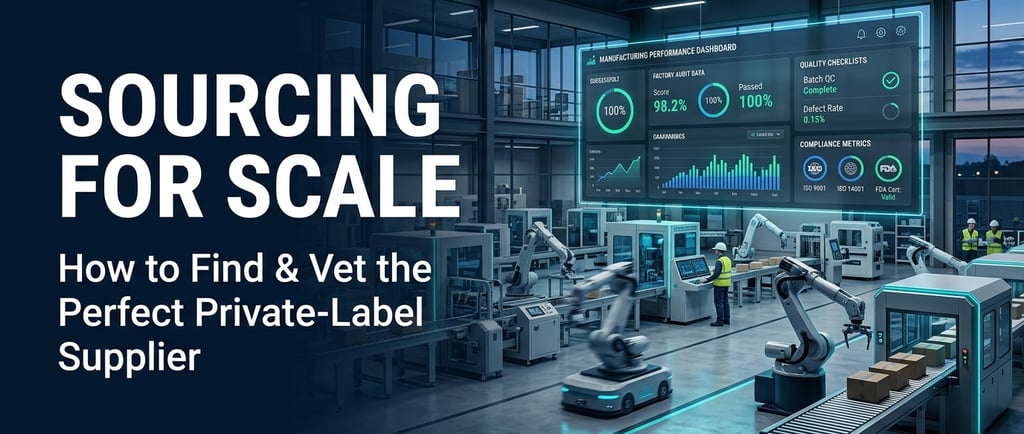
Sourcing for Scale: How to Find and Vet the Perfect Private-Label Supplier
Finding a manufacturer to slap a logo on a generic product is easy. Sourcing an enterprise-grade private-label supplier that protects your margins, manages compliance, and scales with your brand is a completely different game. Discover the operational framework for finding and vetting the perfect manufacturing partner.
4 min read
Sourcing for Scale: How to Find and Vet the Perfect Private-Label Supplier
In the hyper-competitive e-commerce ecosystem, your brand's front-end marketing is only as resilient as its backend supply chain. You can have a flawless digital storefront, an optimized customer acquisition strategy, and a surging consumer audience—but if your manufacturer misses a critical production window, ships a defective batch, or unexpectedly alters their pricing structure, your growth stalls instantly.
For scaling e-commerce businesses diving into private-label brand development, the word "sourcing" is frequently misunderstood. It isn’t merely about browsing online supplier directories, filtering for the lowest per-unit cost, and wiring a deposit. True product sourcing is an exercise in strict risk management, engineering alignment, and strategic relationship building.
If you want to move away from fragile, transactional supplier relationships and build a sustainable brand, here is the operational blueprint for finding, vetting, and securing an enterprise-grade private-label supplier.
1. Navigating the Sourcing Landscape: Beyond Generic Directories
While platforms like Alibaba, Global Sources, and ThomasNet are excellent aggregation points for discovering initial manufacturing candidates, they represent just the surface layer of global procurement. The primary challenge when utilizing these networks is distinguishing between a direct manufacturer (the actual factory) and a middleman (a trading company or broker).
While trading companies have their place for low-volume, off-the-shelf ordering, true private-label brand development requires working directly with the factory floor. Direct factory relationships unlock:
Better baseline margins by eliminating broker markups.
Direct control over custom molds, materials, and engineering adjustments.
Higher priority during peak production seasons.
To bypass the noise of digital directories, established brands often complement online searches by attending tier-one international trade exhibitions or partnering with specialized, on-the-ground sourcing agencies that possess existing networks of pre-vetted factories.
2. The Operational Vetting Framework: Auditing Capabilities
Once you have identified a shortlist of potential suppliers, you must move them through a rigorous operational vetting process. Do not rely on polished digital catalogs or certificates sent via email; instead, evaluate their capabilities against a strict corporate matrix:
Technical and Engineering Expertise
Can the factory actually execute your custom product specifications and quick-turn packaging designs? You need to verify whether they have an in-house R&D and engineering team capable of modifying molds, interpreting technical blueprints, and handling advanced raw material formulations.
Capacity and Scalability
A supplier that struggles to fulfill an initial order of 1,500 units will completely collapse when you scale your multi-channel operations and demand 20,000 units. Ask hard questions regarding their total monthly production capacity, total factory square footage, and how much of their production line is automated.
Flexible Minimum Order Quantities (MOQs)
In an environment governed by volatile consumer demand, look for manufacturers willing to negotiate flexible manufacturing structures. A strategic partner will often allow you to pre-stage raw materials or component blanks in bulk while running smaller, agile assembly runs to test real-time market velocity.
3. De-Risking the Pipeline: QA, Samples, and Compliance
Never place a full-scale production order based entirely on digital renderings. To protect your working capital, your onboarding pipeline must include strict, non-negotiable verification guardrails before any mass production begins.
Step 1: Paid Custom Prototyping (The Acid Test)
Request a physical, fully customized sample that features your exact branding, material specs, and custom packaging. This tests more than just the factory's output; it tests their communication speed, attention to detail, and ability to follow precise spec sheets.
Step 2: Deploy Independent Factory Audits
A factory can easily hand-craft a flawless sample in a specialized laboratory, only for the mass production line to experience widespread defects. Before signing a master manufacturing agreement, deploy independent inspectors to conduct comprehensive factory audits. This process verifies their machinery maintenance schedules, labor standards, and internal quality assurance (QA) protocols.
Step 3: Verify Regulatory Compliance and Certifications
Every target marketplace has rigid compliance standards—whether it is FDA regulation for ingestibles, FCC/CE certification for consumer electronics, or strict safety standards for children's goods. Ensure your supplier holds valid, up-to-date testing documentation from accredited, third-party laboratories (such as SGS, Intertek, or TÜV Rheinland) that perfectly match the legal entity on their manufacturing invoices.
4. Aligning Long-Term Operational Incentives
The final step in securing your private-label supplier is aligning your financial and operational incentives. Treat your manufacturer as a long-term strategic asset, not a line-item expense.
Implement Structured Payment Terms: Avoid paying 100% upfront. Negotiate industry-standard terms (e.g., 30% production deposit, 70% payable only after passing a strict pre-shipment inspection). This ensures the factory remains financially incentivized to maintain quality from the first unit to the last.
Draft a Comprehensive Quality Agreement: Explicitly document your acceptable quality limits (AQL), exact material tolerances, and specific financial penalty clauses for delayed shipments or sub-par merchandise before any capital leaves your bank account.
Take Total Control of Your Procurement with ParaUnion
Finding, vetting, and managing a world-class private-label supplier requires deep market expertise, local presence, and relentless operational discipline. Trying to manage this high-stakes architecture entirely through emails and messaging apps often introduces communication gaps, hidden margin erosion, and missed product launch windows.
At ParaUnion, we act as an extension of your operational team on the ground. We manage the entire manufacturing lifecycle for your brand—from strategic product sourcing and rigorous factory audits to strict upstream quality assurance and seamless cross-border supply chain optimization. We clear the operational hurdles so you can focus entirely on scaling your global market share.
Ready to build a resilient, high-margin manufacturing pipeline with absolute confidence?
Contact the ParaUnion team today to secure your private-label supply chain.
Company
© 2026 ParaUnion Ltd. All rights reserved.
Headquarters
Mississauga, Canada - operating globally.
Our Commitments